
Atomic Energy
This information may be outdated.
If you feel this is in error, please remove the {{outdated}} template.
The Atomic Energy Interest Group at DMS provides an opportunity for members and others interested in nuclear science and its practical applications to engage in discussions and activities. The Group is unapologetically “pro-nuke” and keenly interested in the divers ways that this branch of human knowledge, touching the deepest roots of Nature, can address human needs.
Atomic Energy category on the DMS Talk forum
Activities
Section titled “Activities”- Lecture Classes
- Comanche Peak power station visit (2 September 2014)
- Nuclear Science Day
- Geiger counter build (15 November 2014)
Classes
Section titled “Classes”Responsible citizenship requires the layman to acquire a grasp of nuclear matters if he is to pass intelligent judgments on pressing domestic and international issues.
—Glenn Seaborg, Chairman, USAEC (1963)
Naturally, what we can do in the way of practical experiments and demonstrations is limited by resources, legal questions, health-and-safety concerns, and the need to avoid disturbing other users of the Space. Lectures, however, are easily arranged and have few problems.
- “Introduction to Atomic Energy” lecture series
- “Nuclear and Radiological Accidents”
- “Breeder Reactors”
- “Portable, Mobile, and Vehicle Atomic Power”
- “Nuclear and Thermonuclear Explosives and their Peaceful Uses”
Nuclear Science Day at DMS
Section titled “Nuclear Science Day at DMS”As an observance of National Nuclear Science Week, the DMS Atomic Energy Interest Group has set up displays, shown videos, and given demonstrations on nuclear science and energy topics. National Nuclear Science Week is always the third full week in October, and we have selected the Saturday of this week for our Nuclear Science Day. In 2014 this was the 25th of October 25, and in 2015 it was the 24th.
-
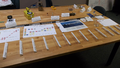
Part of our 2014 displays. The Timeline of Nuclear Science and Energy can be seen, along with instruments for detecting and measuring radiation.
-
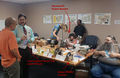
A sampling from the 2015 display. Further details identified by chart brut.
-
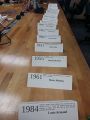
A timeline following the crude initial radioactive observations through the modern atomic age.
-
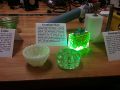
Various members brought in uranium glass from their personal collections.
-
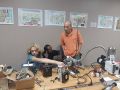
Student Mad-Scientist Joshua Baptist brought in his desktop Farnsworth Fusion Reactor.
File for printing out the Timeline on 5×8 index cards (PDF, 100 kB) — certainly not a complete list of important achievements, people, and terms, but hopefully a good place to start.
DMS Geiger Counter
Section titled “DMS Geiger Counter”The general concept is to read out counts per minute on a display. With a 3-digit display, two ranges, x1 and x100, seem sufficient, since levels above 99 900 cpm (with a beta-gamma counter) are extreme. The power supply will be from a standard 9 V battery. To prolong battery life, the low voltage for the electronics (Vcc, 3.3 V) will be drawn from a buck converter, and the high voltage for the tube (400 V) from a boost converter, both with efficiencies above 75%.
Tube type STS-5 (Russian military surplus), 110 mm long, 12 mm diameter, working voltage 400 V
HV supply LT3420 photoflash chip, with 33 μF 450 V capacitor
LV supply BP3275-33 package DC-DC converter (requires no external components)
Field Trips
Section titled “Field Trips”-
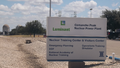
On 2 September 2014, three DMS members visited the Comanche Peak Steam Generating Station, one of only a few atomic power plants in the country which has a visitor center
-
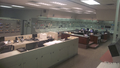
One of the more interesting parts of our visit was being able to see (although not enter) the training control room, an exact duplicate of the real thing
-

Cooling water for the plant comes from Squaw Creek Reservoir, and some of the land on the far side is a semi-public park
Members
Section titled “Members”publius (talk)
Migrated from the legacy DMS wiki: original page