
40-node Raspberry Pi Cluster
This page is archived and kept for historical purposes. Please do not make any edits.
If you feel this is in error, please remove the {{archive}} template.
Introduction
Section titled “Introduction”This cluster is intended to serve as a testbed for distributed applications. Specifically, it’s meant to shine where the number of nodes available for testing is far more important than the overall computing power of the system. The Raspberry Pi was chosen because it is inexpensive, has a small footprint, does not require much power to operate, and performs adequately.
Requirements
Section titled “Requirements”- Build a model supercomputer, which structurally mimics a modern supercomputer.
- All hardware required for the cluster to operate must be housed in a case no larger than a full tower.
- Parts that are likely to fail should be easy to replace.
- It should be space-efficient, energy-efficient, economically-efficient, and well-constructed.
- Ideally, it should be visually pleasing.
Photos
Section titled “Photos”-
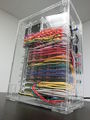
Left
-
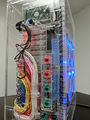
Front
-
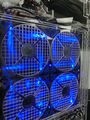
Right
Project members
Section titled “Project members”- David Guill
Status
Section titled “Status”- 1/30/2014 - The cluster is hardware-complete, but does not have software installed yet.
Next Steps
Section titled “Next Steps”- A disk image needs to be built and installed.
- Distributed software needs to be written. This may take years. But it was the point in building it, so that’s fine.
Resources
Section titled “Resources”- David’s cluster write-up: http://likemagicappears.com/projects/raspberry-pi-cluster/
Migrated from the legacy DMS wiki: original page